Difference Between Prokaryotic And Eukaryotic Cell Pdf Viewer
- Main Difference Between Prokaryotes And Eukaryotes
- Prokaryotic And Eukaryotic Similarities
- Eukaryotic And Prokaryotic Cells
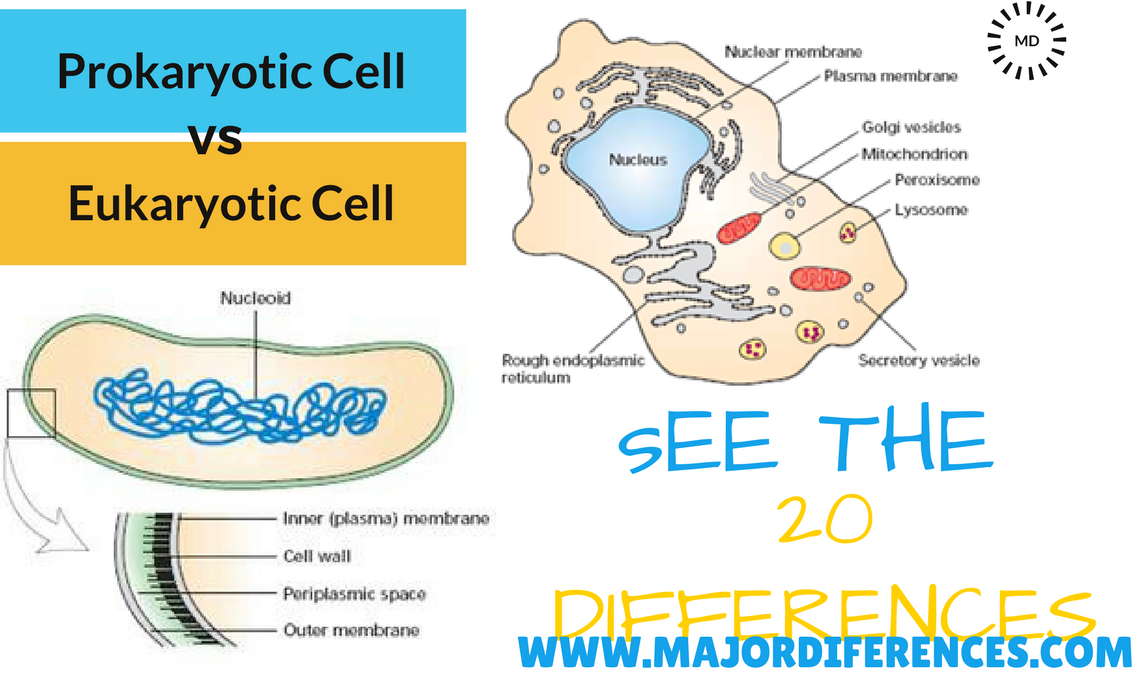
Diagram of a typical prokaryotic bacteria cell A prokaryote is a that lacks a -bound, or any other membrane-bound. The word prokaryote comes from the πρό ( pro) 'before' and κάρυον ( karyon) ' or '. Prokaryotes are divided into two, and. In contrast, species with nuclei and organelles are placed in the,.
CELLS: ORIGINSTable of. Components of Cells. The theory currently. Bang Theory, the idea that all matter in. Universe existed in a cosmic egg (smaller. Prokaryotes and Eukaryotes Biologists have come to realize that the difference between plants. Composition than the cell wall of eukaryotic cells.
Prokaryotes reproduce without fusion of gametes. The are thought to have been prokaryotes. In the prokaryotes, all the intracellular components (, and ) are located together in the enclosed by the, rather than in separate.
Bacteria, however, do possess protein-based, which are thought to act as primitive organelles enclosed in protein shells. Some prokaryotes, such as may form large. Others, such as, have multicellular stages in their.
Have provided insight into the evolution and interrelationships of the three domains of biological species. Eukaryotes are organisms, including humans, whose cells have a well defined membrane-bound nucleus (containing chromosomal DNA) and organelles. The division between prokaryotes and eukaryotes reflects the existence of two very different levels of cellular organization.
Distinctive types of prokaryotes include and; these are common in some extreme environments. : Orange labels: Also see: and Prokaryotes have a, albeit more primitive than that of the eukaryotes.
Main Difference Between Prokaryotes And Eukaryotes
Besides homologues of actin and tubulin ( and ), the helically arranged building-block of the, is one of the most significant cytoskeletal proteins of bacteria, as it provides structural backgrounds of, the basic cell physiological response of bacteria. At least some prokaryotes also contain intracellular structures that can be seen as primitive organelles. Membranous organelles (or intracellular membranes) are known in some groups of prokaryotes, such as vacuoles or membrane systems devoted to special metabolic properties, such as. In addition, some species also contain carbohydrate-enclosed microcompartments, which have distinct physiological roles (e.g. Or gas vacuoles). Most prokaryotes are between 1 µm and 10 µm, but they can vary in size from 0.2 µm ( ) to 750 µm ( ). Prokaryotic cell structure (only in some types of prokaryotes) Long, whip-like protrusion that aids cellular locomotion used by both gram positive and gram negative organisms.
Surrounds the cell's cytoplasm and regulates the flow of substances in and out of the cell. (except genera and ) Outer covering of most cells that protects the bacterial cell and gives it shape.
A gel-like substance composed mainly of water that also contains enzymes, salts, cell components, and various organic molecules. Cell structures responsible for protein production. Area of the cytoplasm that contains the prokaryote's single DNA molecule. (only in some types of prokaryotes) A - covering that surrounds the cell membranes. It contains the inclusion bodies like ribosomes and larger masses scattered in the cytoplasmic matrix. Morphology Prokaryotic cells have various shapes; the four basic shapes of bacteria are:.
Prokaryotic And Eukaryotic Similarities
– spherical. – rod-shaped.
– spiral-shaped. – comma-shaped The archaeon has flat square-shaped cells. Reproduction Bacteria and archaea reproduce through, usually. Genetic exchange and recombination still occur, but this is a form of and is not a replicative process, simply involving the transference of DNA between two cells, as in. DNA transfer DNA transfer between prokaryotic cells occurs in bacteria and archaea, although it has been mainly studied in bacteria.
In bacteria, gene transfer occurs by three processes. These are (1) bacterial virus -mediated, (2) -mediated, and (3). Transduction of bacterial genes by bacteriophage appears to reflect an occasional error during intracellular assembly of particles, rather than an of the host bacteria. The transfer of bacterial DNA is under the control of the bacteriophage’s genes rather than bacterial genes. Conjugation in the well-studied E.
Coli system is controlled by plasmid genes, and is an adaptation for distributing copies of a plasmid from one bacterial host to another. Infrequently during this process, a plasmid may integrate into the host bacterial chromosome, and subsequently transfer part of the host bacterial DNA to another bacterium. Plasmid mediated transfer of host bacterial DNA (conjugation) also appears to be an accidental process rather than a bacterial adaptation. 3D animation of a prokaryotic cell that shows all the elements that compose it Natural bacterial involves the transfer of DNA from one bacterium to another through the intervening medium. Unlike transduction and conjugation, transformation is clearly a bacterial for DNA transfer, because it depends on numerous bacterial gene products that specifically interact to perform this complex process. For a bacterium to bind, take up and recombine donor DNA into its own chromosome, it must first enter a special physiological state called. About 40 genes are required in Bacillus subtilis for the development of competence.
The length of DNA transferred during B. Subtilis transformation can be as much as a third to the whole chromosome. Transformation is a common mode of DNA transfer, and 67 prokaryotic species are thus far known to be naturally competent for transformation. Among archaea, Halobacterium volcanii forms cytoplasmic bridges between cells that appear to be used for transfer of DNA from one cell to another. Another archaeon, Sulfolobus solfataricus, transfers DNA between cells by direct contact. Found that exposure of S. Solfataricus to DNA damaging agents induces cellular aggregation, and suggested that cellular aggregation may enhance DNA transfer among cells to provide increased repair of damaged DNA via homologous recombination.
Sociality While prokaryotes are considered strictly unicellular, most can form stable aggregate communities. When such communities are encased in a stabilizing polymer matrix ('slime'), they may be called '. Cells in biofilms often show distinct patterns of (phenotypic differentiation) in time and space.
Also, as with multicellular eukaryotes, these changes in expression often appear to result from, a phenomenon known as. Biofilms may be highly heterogeneous and structurally complex and may attach to solid surfaces, or exist at liquid-air interfaces, or potentially even liquid-liquid interfaces. Bacterial biofilms are often made up of microcolonies (approximately dome-shaped masses of bacteria and matrix) separated by 'voids' through which the medium (e.g., water) may flow easily. The microcolonies may join together above the substratum to form a continuous layer, closing the network of channels separating microcolonies. This structural complexity—combined with observations that oxygen limitation (a ubiquitous challenge for anything growing in size beyond the scale of diffusion) is at least partially eased by movement of medium throughout the biofilm—has led some to speculate that this may constitute a and many researchers have started calling prokaryotic communities multicellular (for example ).
Differential cell expression, collective behavior, signaling, and (in some cases) discrete events all seem to point in this direction. However, these colonies are seldom if ever founded by a single founder (in the way that animals and plants are founded by single cells), which presents a number of theoretical issues. Most explanations of and the have focused on high relatedness between members of a group (or colony, or whole organism).
If a copy of a gene is present in all members of a group, behaviors that promote cooperation between members may permit those members to have (on average) greater fitness than a similar group of selfish individuals (see and ). Should these instances of prokaryotic sociality prove to be the rule rather than the exception, it would have serious implications for the way we view prokaryotes in general, and the way we deal with them in medicine. Bacterial biofilms may be 100 times more resistant to antibiotics than free-living unicells and may be nearly impossible to remove from surfaces once they have colonized them.
Other aspects of bacterial cooperation—such as and quorum-sensing-mediated, present additional challenges to researchers and medical professionals seeking to treat the associated diseases. Environment. Phylogenetic ring showing the diversity of prokaryotes, and symbiogenetic origins of eukaryotes Prokaryotes have diversified greatly throughout their long existence. The metabolism of prokaryotes is far more varied than that of eukaryotes, leading to many highly distinct prokaryotic types. For example, in addition to using or for energy, as eukaryotes do, prokaryotes may obtain energy from such as.
Eukaryotic And Prokaryotic Cells
This enables prokaryotes to thrive in harsh environments as cold as the snow surface of, studied in or as hot as undersea and land-based. Prokaryotes live in nearly all environments on Earth. Some archaea and bacteria are, thriving in harsh conditions, such as high temperatures or high salinity. Many archaea grow as in the oceans. Prokaryotes live in or on the bodies of other organisms, including humans.
Classification. Phylogenetic and tree of living organisms, showing the origins of and prokaryotes In 1977, proposed dividing prokaryotes into the and (originally Eubacteria and Archaebacteria) because of the major differences in the structure and genetics between the two groups of organisms. Archaea were originally thought to be extremophiles, living only in inhospitable conditions such as extremes of, and but have since been found in all types of. The resulting arrangement of Eukaryota (also called 'Eucarya'), Bacteria, and Archaea is called the, replacing the traditional. Evolution. Diagram of the origin of life with the Eukaryotes appearing early, not derived from Prokaryotes, as proposed by Richard Egel in 2012. This view, one of many on the relative positions of Prokaryotes and Eukaryotes, implies that the universal common ancestor was relatively large and complex.
A widespread current model of the evolution of the is that these were some form of prokaryotes, which may have evolved out of, while the eukaryotes evolved later in the history of life. Some authors have questioned this conclusion, arguing that the current set of prokaryotic species may have evolved from more complex eukaryotic ancestors through a process of simplification. Others have argued that the three domains of life arose simultaneously, from a set of varied cells that formed a single gene pool. This controversy was summarized in 2005: There is no consensus among biologists concerning the position of the eukaryotes in the overall scheme of cell evolution. Comparison of eukaryotes vs. Prokaryotes The division between prokaryotes and eukaryotes is usually considered the most important distinction or difference among organisms. The distinction is that eukaryotic cells have a 'true' containing their, whereas prokaryotic cells do not have a nucleus.
Both eukaryotes and prokaryotes contain large / structures called, which. Another difference is that in prokaryotes are smaller than in eukaryotes. However, two organelles found in many eukaryotic cells, and, contain ribosomes similar in size and makeup to those found in prokaryotes.
This is one of many pieces of evidence that mitochondria and chloroplasts are themselves from free-living bacteria. This theory holds that early eukaryotic cells took in primitive prokaryotic cells by and adapted themselves to incorporate their structures, leading to the mitochondria we see today. The in a prokaryote is held within a DNA/protein complex in the called the, which lacks a. The complex contains a single, cyclic, double-stranded molecule of stable chromosomal DNA, in contrast to the multiple linear, compact, highly organized found in eukaryotic cells.
In addition, many important genes of prokaryotes are stored in separate circular DNA structures called. Prokaryotes lack and. Instead, processes such as and take place across the prokaryotic. However, prokaryotes do possess some internal structures, such as.
It has been suggested that the bacterial order have a membrane around their nucleoid and contain other membrane-bound cellular structures. However, further investigation revealed that Planctomycetes cells are not compartmentalized or nucleated and like the other bacterial membrane systems are all interconnected. Prokaryotic cells are usually much smaller than eukaryotic cells. Therefore, prokaryotes have a larger, giving them a higher, a higher growth rate, and as a consequence, a shorter generation time than eukaryotes. See also.
The oldest known multicellular eukaryote is believed to be Grypania spiralis, whose fossil dates back to about 2.1 billion years. It can be found as thin films of carbon in Negaunee iron formation at the Empire Mine near Ishpeming, Michigan.Cells have been broadly classified as: prokaryotic cells and eukaryotic cells. These terms come from the Greek word 'karyon' which means 'nucleus'. This nucleus is considered as the brain of the cell, which directs it properly.
'Pro' means 'before' and 'eu' means 'true'. Thus, prokaryotic cells do not have a nucleus and are supposed to be primitive in nature, while the eukaryotic cells have evolved from the former ones, and show the presence of a nucleus.